Research → Influence
Situation
Artefact91 designed and built Always On, Issue 01 of IIBD's zine series, written by Romain Williams and Dara Dillon and published 25 November 2026. The issue examines how ordinary technology — family location sharing, household admin accounts, court-ordered co-parenting apps, shared cloud libraries — extends and intensifies intimate-partner violence. Our brief was to turn a research argument into a thirteen-spread interactive publication, and to leave behind an instrument other organisations could pick up and apply to their own systems.
Decision
To publish research on technology-facilitated gender-based violence in a form that a policy reader, a product team and a frontline worker would each finish — and to move the question from what a survivor should do to what a system should be accountable for. The publication had to carry a sequenced argument, make its evidence legible without a legend, and be safe to open on a device that may be monitored.


Sensitive subject matter, a mixed audience, and an evidence base that is thin in exactly the place the argument needed it: of 102 sources reviewed, 12 tested whether an intervention actually reduced harm. Every interactive component therefore had to be honest about its own status — modelled figures labelled as modelled, unsourced dates left visibly open, product classes named instead of companies. The publication also needed a quick-exit path, composite and fictional scenarios throughout, and support information placed where a reader in difficulty would reach it.

Movement
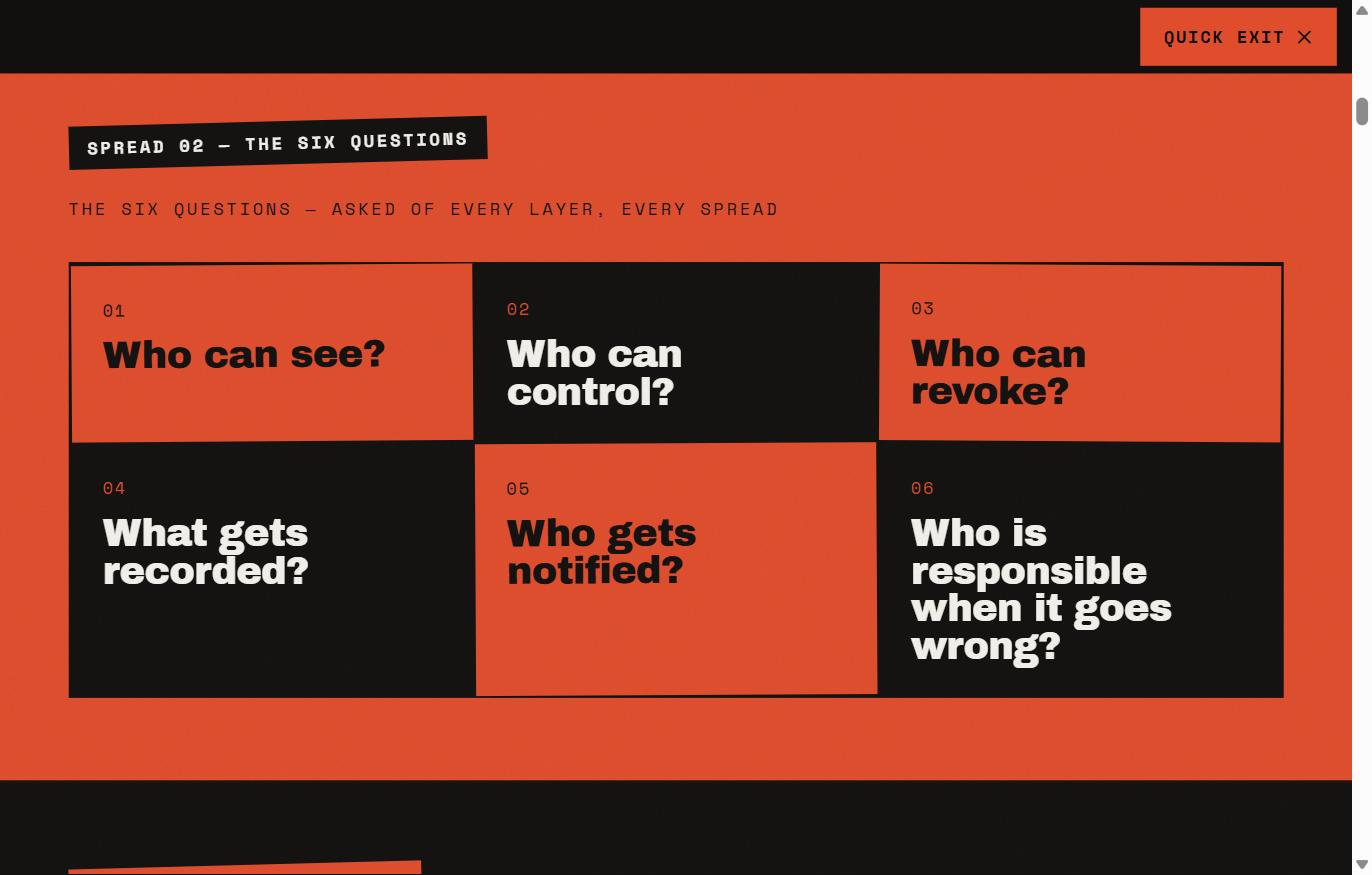
A thirteen-spread interactive zine built on six accountability questions asked of every layer. It carries a permission table tracking eighteen access cells across three relationship stages, a data-trail walkthrough from device to account holder, a modelled platform distribution sequence, an exit-cost calculator, a comparison of eight product classes against five safety questions, and the TFGBV Accountability Index — a six-layer, twenty-four-point scoring instrument with critical-failure flags and a downloadable result card. The Index is released under CC BY 4.0 so other organisations can score their own products, services and institutions and publish the result. The issue is identified by its date rather than a version number.


