Advocacy
Situation
Advocacy days fail in a predictable way. A sector arrives at a legislature with a general case, each organization carries its own priorities into its own meetings, and the collective weight of the sector is spent across a dozen different messages. Legislators hear volume rather than a demand, and nothing is left behind that a staffer can act on.
The Enchanté Network represents more than 300 member organizations. Scale on that order is only an asset if it resolves into one thing a legislator can say yes to. The underlying problem — thirty years of persistent wage gaps, job insecurity and systemic exclusion for 2SLGBTQIA+ workers — was large enough to generate many plausible asks, which is exactly the condition that produces none.
Decision
Run it as a single-ask campaign rather than a sector showcase.
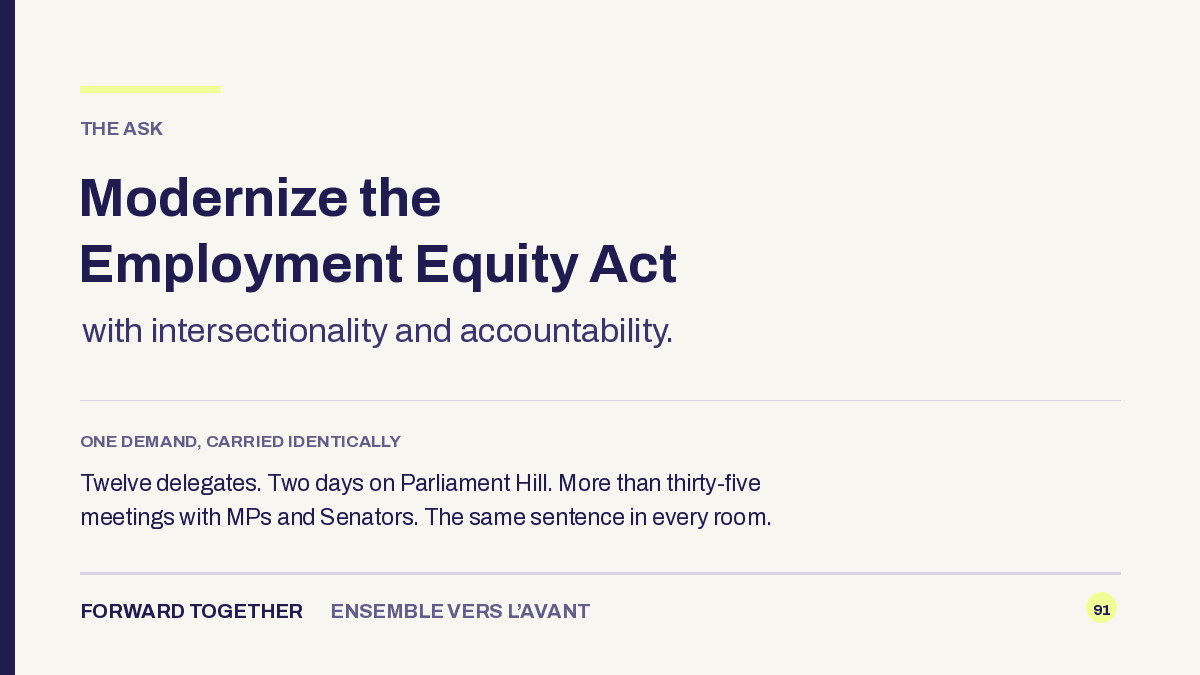
The ask was modernization of the Employment Equity Act, with intersectionality and accountability named as the specific changes sought. One piece of legislation. One demand. Carried identically into every meeting by every delegate.
That choice set everything downstream. It determined who needed to be in the room — a coalition broad enough that the ask could not be read as any single organization's interest. It determined what delegates were briefed to say, and what they were briefed to leave alone. And it set what the two days had to produce: not awareness, but a countable number of parliamentarians who had heard the same specific request from people whose constituencies they recognized.
A coalition only holds if each organization can see itself in it. Eight stood behind the campaign — LGBT Youth Line, CQLGBT, The Enchanté Network, Alter Acadie, 2Spirit Consulting, Qmunity, Pride at Work Canada and the Pride Centre of Edmonton — spanning youth services, regional centres, Two-Spirit leadership, francophone and Acadian organizations, and workplace advocacy. Pride at Work Canada co-organized.
The campaign identity had to carry that range without flattening it. Forward Together / Ensemble vers l'avant was built bilingual from the outset rather than translated afterwards, with every partner named on the banner. A delegate from any one of the eight could stand in front of it without the campaign reading as somebody else's.
The meeting program was built for compression: twelve delegates, two days, and a schedule dense enough for the same ask to land more than thirty-five times.
Movement
More than 35 meetings with MPs and Senators across two days, from twelve delegates. That rate is only achievable when every delegate carries the same ask and no time in the room is spent establishing what the coalition wants.
The campaign put one specific legislative request in front of a large number of parliamentarians inside a compressed window, under a banner eight organizations had signed. It did not close with a statement of concern. It closed with a demand that can be repeated, checked against and returned to in the next session.
That is what a national network becomes when it is organized as a campaign rather than a presence.